Better prompts create better outputs
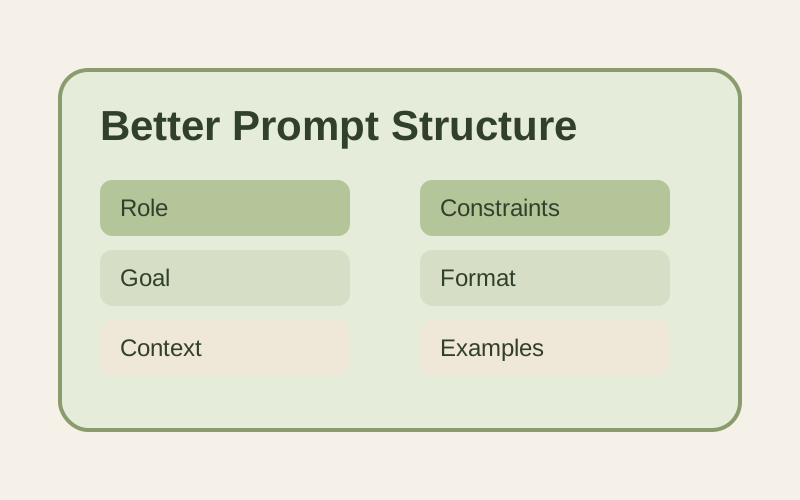
Generative AI is not magic. It responds to the direction you give it. A vague prompt often creates vague, generic, or incomplete answers. A strong prompt gives the model context, a goal, constraints, and a desired output format.
- It reduces confusion and irrelevant output.
- It improves accuracy, usefulness, and structure.
- It saves time because you need fewer retries.
- It makes AI more helpful for school, work, and personal projects.
Be specific about the goal
Tell the model exactly what you want. Instead of “help me write,” say “write a professional email asking for an interview confirmation.”
Give context
Include important background details such as your audience, topic, assignment, role, or business need. Context helps the AI tailor its response.
Set constraints
State limits such as word count, tone, reading level, format, or what should be included or avoided. Constraints make results more usable.
Ask for a format
Tell the AI how to present the response: bullets, table, paragraph, outline, study guide, code block, or slide-friendly text.
Refine through iteration
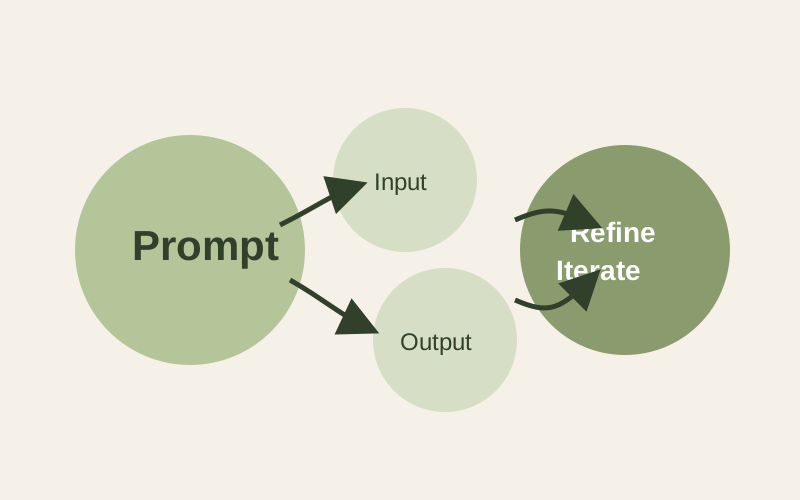
Your first prompt does not have to be perfect. Review the result, then ask the AI to revise, shorten, expand, simplify, or reorganize it.
Weak prompt
Tell me about prompting.
This is too broad. The AI has no audience, purpose, structure, or depth target.
Strong prompt
Explain the five principles of prompting for a college audience. Use plain language, include one example for each principle, and format the response with section headings.
This version sets the topic, audience, tone, detail level, and format.
Use this prompt starter
Act as a [role].
Help me [goal].
The context is [background].
Please include [must-have details].
Keep it [constraints].
Format the output as [format].
Prompting is a skill
Effective prompting is less about one “perfect” command and more about learning how to guide the model. When you combine clear goals, useful context, constraints, and iteration, generative AI becomes much more effective.